
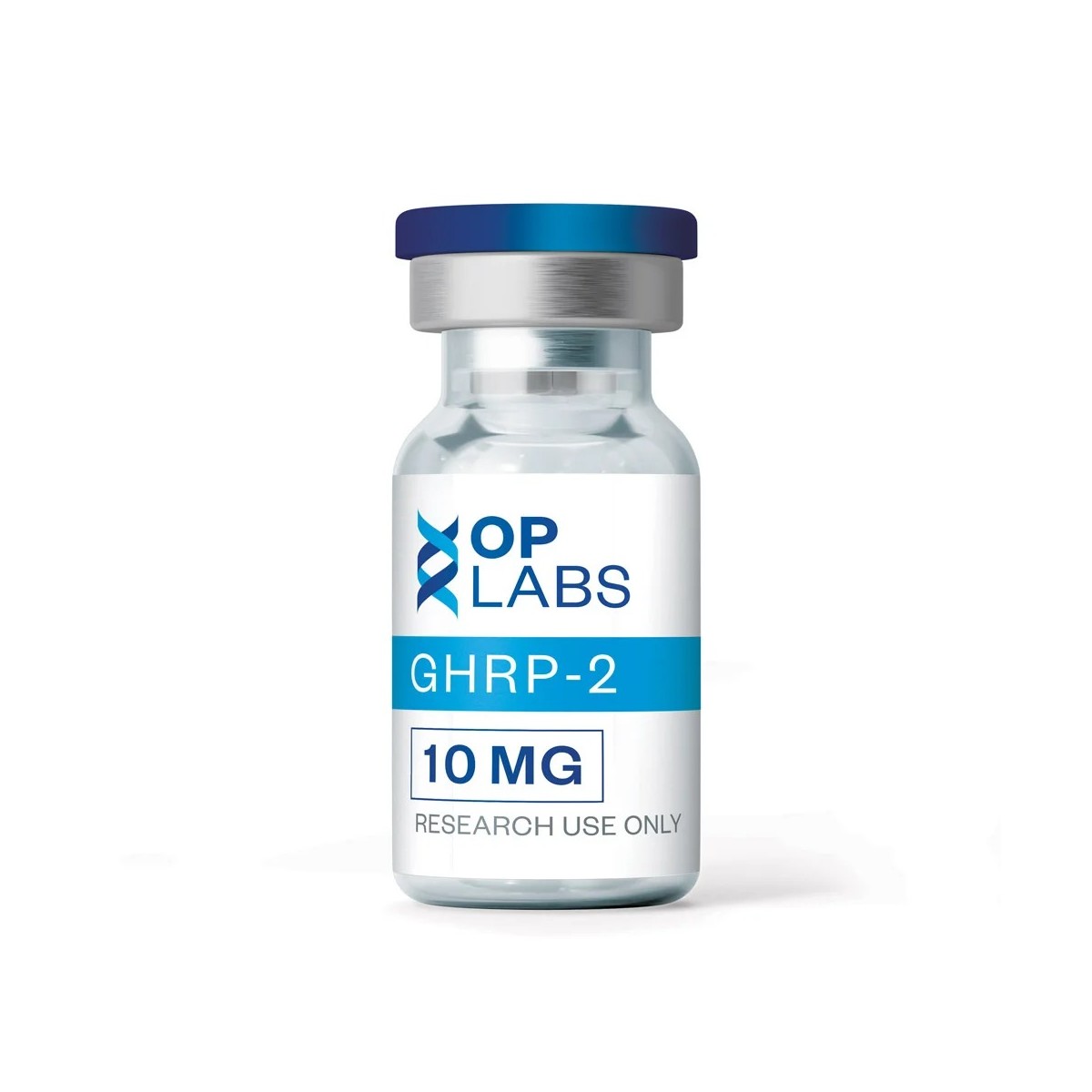

GHRP-2 is a specialised research peptide used in scientific investigation of growth hormone secretagogue activity, receptor-mediated signalling, and neuroendocrine regulatory pathways.
GHRP-2 is a synthetic hexapeptide belonging to the class of growth hormone secretagogues, widely utilised in biochemical and physiological research to study receptor-mediated signalling within the hypothalamic–pituitary axis. It functions primarily as an agonist of the growth hormone secretagogue receptor (GHS-R1a), a G-protein-coupled receptor expressed in both central and peripheral tissues.
In cellular and in vivo research systems, GHRP-2 activates GHS-R1a independently of endogenous growth hormone-releasing hormone (GHRH), leading to downstream intracellular signalling cascades involving calcium mobilisation and modulation of second messenger pathways. These effects make GHRP-2 a useful molecular tool for investigating receptor activation dynamics, neuroendocrine regulation, and peptide–receptor interactions.
In preclinical research settings, exposure to GHRP-2 has been associated with altered signalling along the hypothalamic–pituitary axis, with downstream effects dependent on experimental model, dose, and exposure conditions. As such, GHRP-2 is commonly employed in mechanistic studies exploring peptide hormone signalling and receptor pharmacology.
Applications in Research
As a molecular probe to study growth hormone secretagogue receptor (GHS-R1a) activation
Investigation of neuroendocrine signalling pathways within the hypothalamic–pituitary axis
In cell-based assays examining GPCR-mediated signal transduction and calcium flux
In animal or ex vivo experimental models for mechanistic studies of peptide hormone signalling
As a reference compound in receptor binding, agonist profiling, and structure–activity studies
Precautions & Notes
Experimental behaviour of MOTS-c is influenced by metabolic state, cell type, and peptide concentration.
Buffer composition, pH, and ionic strength may affect peptide stability.
Appropriate controls are recommended.
Intended strictly for laboratory research use.
GHRP-2 is a specialised research peptide used in scientific investigation of growth hormone secretagogue activity, receptor-mediated signalling, and neuroendocrine regulatory pathways.

@CUSTOMER_NAME@
@AUTHOR_PROFILE@ @COMMENT_ISO_COUNTRY@@COMMENT_TITLE@
@COMMENT_COMMENT@